
Owid Scrapper
by mdhorilabs
Scrapper and Automation serving dataset of charts from Our World In Data, make fast your projects
Opens on Apify.com
About Owid Scrapper
Scrapper and Automation serving dataset of charts from Our World In Data, make fast your projects
What does this actor do?
Owid Scrapper is a web scraping and automation tool available on the Apify platform. It's designed to help you extract data and automate tasks efficiently in the cloud.
Key Features
- Cloud-based execution - no local setup required
- Scalable infrastructure for large-scale operations
- API access for integration with your applications
- Built-in proxy rotation and anti-blocking measures
- Scheduled runs and webhooks for automation
How to Use
- Click "Try This Actor" to open it on Apify
- Create a free Apify account if you don't have one
- Configure the input parameters as needed
- Run the actor and download your results
Documentation
OWID (Our World In Data) Scrapper Charts Automation serving dataset of charts from Our World In Data, make fast your projects ## 🎯 Features - Multiple Charts Scrapping: allow multiple input in single action - Export the requested dataset with a neat structure: one chart one dataset ## 🚀 How To Use ### 1. Fill Urls Chart the url mostly with prefix "https://ourworldindata.org/grapher/{chart_name}" example source bellow 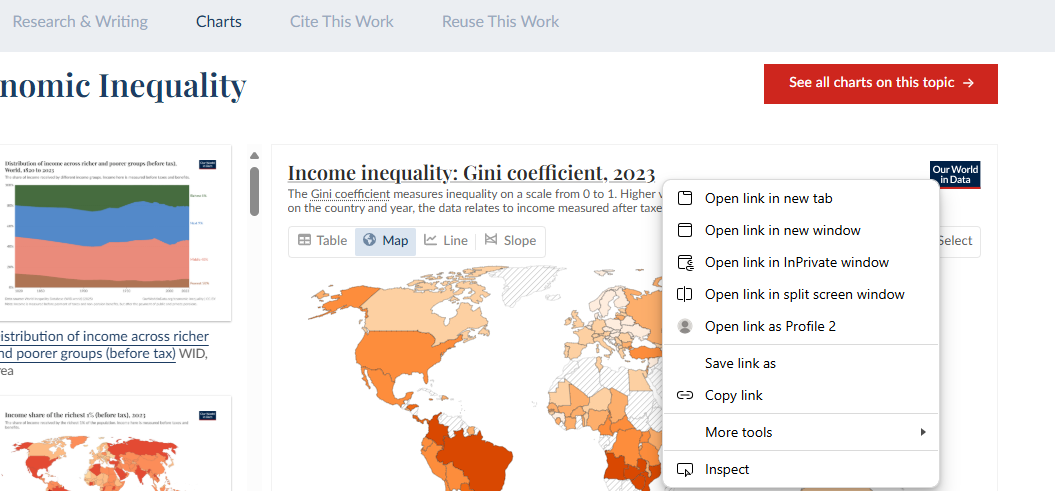 ### 2. Collect your data After click your run, click section
 storage and select many dataset for this run 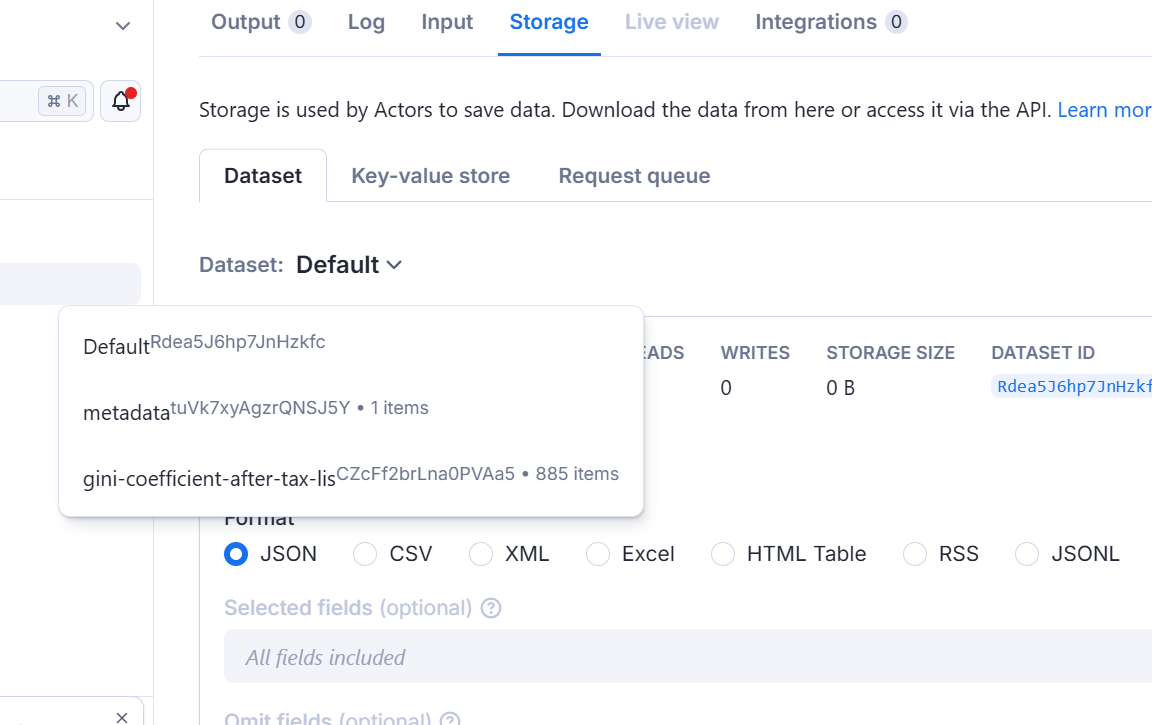 ## 📌 Dataset Details metadata: This is a note from the received dataset and details of the dataset chart. {chart_name}: The primary datasets name is from chart name default: Default dataset is not used ## 📌 Sample Output
 # dataset/metadata { "url": "https://ourworldindata.org/grapher/gini-coefficient-after-tax-lis", "datasetId": "gini-coefficient-after-tax-lis", "detail": { "chart": { "title": "Income inequality: Gini coefficient (after tax)", "subtitle": "The [Gini coefficient](#dod:gini) measures inequality on a scale from 0 to 1. Higher values indicate higher inequality. Inequality is measured here in terms of income after taxes and benefits.", "note": "Income has been [equivalized](#dod:equivalization).", "citation": "Luxembourg Income Study (2024)", "originalChartUrl": "https://ourworldindata.org/grapher/gini-coefficient-after-tax-lis?v=1&csvType=full", "selection": [ "United States", "Chile", "South Africa", "Brazil", "France", "China" ] }, "columns": { "Gini coefficient (Disposable household income, equivalized)": { "titleShort": "Gini coefficient (Disposable household income, equivalized)", "titleLong": "Gini coefficient (Disposable household income, equivalized)", "descriptionShort": "The Gini coefficient measures inequality on a scale from 0 to 1. Higher values indicate higher inequality.", "descriptionKey": [ "Income is \"post-tax\" — measured after taxes have been paid and most government benefits have been received.", "Income has been equivalized – adjusted to account for the fact that people in the same household can share costs like rent and heating." ], "descriptionProcessing": "We create the Luxembourg Income Study data from standardized household survey microdata available in their [LISSY platform](https://www.lisdatacenter.org/data-access/lissy/). The estimations follow the methodology available in LIS, Key Figures and DART platform.\n\nWe obtain after tax income by using the disposable household income variable (`dhi`).\n\nWe estimate before tax income by calculating the sum of income from labor and capital (variable `hifactor`), cash transfers and in-kind goods and services from privates (`hiprivate`) and private pensions (`hi33`). We do this only for surveys where tax and contributions are fully captured, collected or imputed.\n\nWe obtain after tax income (cash) by using the disposable household cash income variable (`dhci`).\n\nWe convert income data from local currency into international-$ by dividing by the [LIS PPP factor](https://www.lisdatacenter.org/resources/ppp-deflators/), available as an additional database in the LISSY platform.\n\nWe top and bottom-code incomes by replacing negative values with zeros and setting boundaries for extreme values of log income: at the top Q3 plus 3 times the interquartile range (Q3-Q1), and at the bottom Q1 minus 3 times the interquartile range.\n\nWe equivalize incomes by dividing each household observation by the square root of the number of household members (nhhmem). Per capita estimates are calculated by dividing incomes by the number of household members.\n\n\nWe obtain Gini coefficients by using [Stata’s ineqdec0 function](https://ideas.repec.org/c/boc/bocode/s366007.html). We set weights as the product between the number of household members (nhhmem) and the normalized household weight (hwgt). We also calculate mean and median values from this function.", "shortUnit": "", "unit": "", "timespan": "1963-2022", "type": "Numeric", "owidVariableId": 1009263, "shortName": "gini_dhi_eq", "lastUpdated": "2025-01-24", "nextUpdate": "2025-07-26", "citationShort": "Luxembourg Income Study (2024) – with major processing by Our World in Data", "citationLong": "Luxembourg Income Study (2024) – with major processing by Our World in Data. “Gini coefficient (Disposable household income, equivalized) – Luxembourg Income Study” [dataset]. Luxembourg Income Study, “Luxembourg Income Study (LIS)” [original data].", "fullMetadata": "https://api.ourworldindata.org/v1/indicators/1009263.metadata.json" } }, "dateDownloaded": "2025-06-26", "activeFilters": {} } } # dataset/gini-coefficient-after-tax-lis [ { "Entity": "Australia", "Code": "AUS", "Year": 1981, "Gini coefficient (Disposable household income, equivalized)": 0.282 }, { "Entity": "Australia", "Code": "AUS", "Year": 1985, "Gini coefficient (Disposable household income, equivalized)": 0.293 }, { "Entity": "Australia", "Code": "AUS", "Year": 1989, "Gini coefficient (Disposable household income, equivalized)": 0.304 }, { "Entity": "Australia", "Code": "AUS", "Year": 1995, "Gini coefficient (Disposable household income, equivalized)": 0.311 }, ... ]
Categories
Common Use Cases
Market Research
Gather competitive intelligence and market data
Lead Generation
Extract contact information for sales outreach
Price Monitoring
Track competitor pricing and product changes
Content Aggregation
Collect and organize content from multiple sources
Ready to Get Started?
Try Owid Scrapper now on Apify. Free tier available with no credit card required.
Start Free TrialActor Information
- Developer
- mdhorilabs
- Pricing
- Paid
- Total Runs
- 138
- Active Users
- 3
Related Actors

Video Transcript Scraper: Youtube, X, Facebook, Tiktok, etc.
by invideoiq

Linkedin Profile Details Scraper + EMAIL (No Cookies Required)
by apimaestro

Twitter (X.com) Scraper Unlimited: No Limits
by apidojo

Content Checker
by jakubbalada
Apify provides a cloud platform for web scraping, data extraction, and automation. Build and run web scrapers in the cloud.
Learn more about ApifyNeed Professional Help?
Couldn't solve your problem? Hire a verified specialist on Fiverr to get it done quickly and professionally.
Trusted by millions | Money-back guarantee | 24/7 Support